



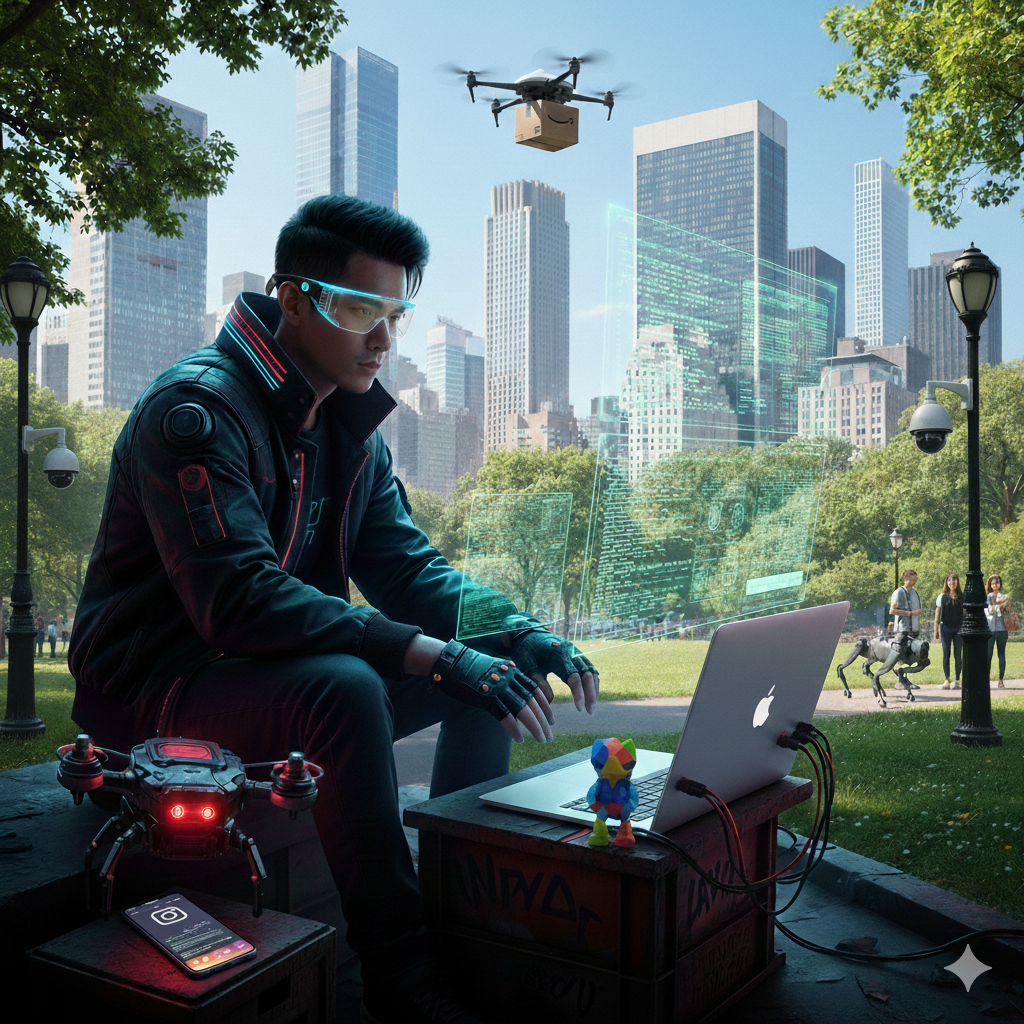
Science fiction, at some level, always tries to predict the future. From the craziest visions from the book All Tomorrows to the subtle changes in the world of the movie Her, writers and creators of the ever-changing genre seem to persistently showcase the advancements of humankind and its effect on people. As stated before, not all science fiction speculates at the same scale. Suspension of disbelief allows us to accept faster-than-light travel, space lasers, and giant robots; but smaller-scale stories don't have to make big changes to request a suspension of disbelief. These worlds of lesser scale seem much more similar to ours and may seem more plausible to see in a nearby future, possibly in ten or twenty years. However, all near-future fiction is written with the risk of quickly becoming obsolete. Whether due to the advancements of technology, their erroneous guesses of the future, or even their correct guesses, speculative science fiction always fossilizes the era in which it was written. Yet, there is a science fiction subgenre that is, in my opinion, at risk of becoming obsolete due to the possibility of not being fiction anymore: the cyberpunk genre.
Neon Buildings, Smart Machines, and Existential Dread
Cyberpunk had its origins in the '60s and early '70s; it was part of a broader movement of New Wave science fiction that was clearly a reflection of the new advancements of technology at the time. During the 1960s, humanity began developing computers, the first lasers, and the fundamentals of coding, which revolutionized how technology could expand the human experience. In fact, thanks to all these advancements, the United States was able to put a man on the moon—the culmination of what the technology of the time could do. In spite of this, writers were intrigued by the grim possibilities of how society would interact with these technologies; a clear reflection of the turbulent times that societies faced during the '60s. This mixture of social exploration and technology gave birth to the cyberpunk genre as we know it, and later movies like Blade Runner, Ghost in the Shell, RoboCop, and Akira codified the visual tropes to represent this specific type of science fiction.
Cyberpunk, in short, is described as: “High tech, low life.” The "cyber"/high-tech part is showcased by the giant glowing buildings owned by massive companies, the improbable flying car which traverses an ever-raining city, and your favorite flavor of robot, cyborg, or clone which can be indistinguishable from a normal human. The "punk"/low-life part is shown by the typical protagonists that are involved in these stories: people with little amount of power or determination in their own lives; police officers surrounded by corruption like Murphy from RoboCop, or gang members without possibilities of escaping a cruel life like David Martinez from Edgerunners. Thematically, cyberpunk uses the high contrast between hyper-advanced technology—which should improve quality of life—and the impoverished state of the people inhabiting the setting. This then allows authors to point out the systemic failings of their world in a clear manner while posing different questions about transhumanism, class struggle, identity, capitalism, and social decay. In cyberpunk, humanity is always in question due to the ever-encroaching advancement of technology; in these settings, it is common for protagonists to question the line between technology and human, which becomes blurred between cybernetic replacements of their bodies, the transfer of human consciousness thanks to technology, or the creation of disposable life.
Another important aspect of cyberpunk as a genre relies on its heavy-handed criticism of uncontrolled capitalism: the giant corporations that in many cases govern cities, governments that extract and use every bit of information of their citizens, and entities that act with complete impunity in their greedy need for more money. Corporations or governments usually appear as the default antagonists due to their immoral methods of profiting, but they can also appear as huge entities that are so big that no single protagonist can take them down effectively. Nonetheless, they are not the only ones that reflect this criticism. Criminal organizations such as cartels, yakuza, or street gangs are also common sights in these stories, and they symbolize a dark response in a world controlled by technology and greed; they use the same exploitative tactics that big corporations utilize to extract things of value from the unfortunate souls that live in this genre, pushing them to extreme measures in order to survive. Because of the design of the genre and its tropes, cyberpunk stories are melancholic, gritty, and dark, showing the common struggles of the everyman in a world that is indifferent to them.
The relatability of the genre has proven true, as its popularity has a wide cultural footprint in Hollywood, video games, fashion, and obviously, technology. What becomes worrying is when reality becomes far too similar to the thought experiments of fiction.
Way Too Real for a Movie
Imagine the following: “In the near future, a computer scientist for a powerful technology company suffers an accident. He suffers from chronic pain and can’t get any help since he was denied assistance by the CEO. In retaliation, the scientist plots his revenge against the CEO of the company as he is tired of the exploitation many have suffered. Using his wits and advanced technology, he is able to design a disposable weapon, locate the CEO in the huge sprawling city, evade cameras and security, and finally manages to shoot down the evil CEO to fulfill his revenge. However, he is captured, imprisoned, and the company still moves forward like nothing happened.”
Sounds like a synopsis out of a Hollywood production, but in reality, it is a slightly tweaked retelling of the assassination of the UnitedHealthcare CEO at the hand of the purported killer Luigi Mangione. In the real world, Mr. Mangione was an engineer/computer scientist who had several health issues. If the allegations and manifesto are to be believed, he was also the mastermind behind the execution of the CEO Brian Thompson due to the inaccessibility of healthcare in the USA while UnitedHealthcare was among the wealthiest companies in the country; and currently, he is under trial for his actions while the company remained largely unchanged. If we pay close attention, we can see the same themes that are usually reflected in any given cyberpunk story. There is a class struggle of a working man against an unbelievably rich corporation which profits unfairly from people. There is the criminal element in the actions taken by Luigi Mangione in the alleged vendetta against said company. There is the value of human life measured by the supposed killer against the value that a healthcare company arbitrarily gives to millions of people. And most importantly, we have the use of incredible technologies which are deeply intertwined with the succession of events: 3D printing, CAD designing, social engineering, and obviously, the Internet.
In my opinion, there is no denying that we’re living in a time in which fiction is beginning to be surpassed by reality. With the recent AI boom of the last few years, we’ve seen the exponential growth of these apps and programs to the point that they are starting to become indistinguishable at first glance. We have them replacing people’s work, imitating them, or supplanting famous individuals online for memes; we have them creating articles for magazines and clickbait engagement; and most worrying of all, there have been cases of people falling in love with AI chatbots. If you need more evidence of our cyberpunk setting IRL, we have governments using technology to spy, profile, and manipulate people; currently, there are countries increasingly applying surveillance methods for the general populace (like in the U.K. with the implementation of the Digital ID). A government having access to all the information of its populace can effectively control and suppress them with total impunity, much like the anime Psycho-Pass, in which the dystopian Japanese government tracks every single moment of every citizen and may arrest them even before they think of committing a crime. The more similarities I find, the more eerie life becomes.
Another Type of Future Punk
In spite of all the apparent similarities with the dystopian neon-lit genre, I have a certainty that we’re not completely immersed in the genre. Cyberpunk stories also work as cautionary tales; they show us that the failure of institutional systems and technologies can submerge lives in wondrous technological misery, but this is not necessarily a final form for society. Humanity is always essential in the genre. It is common for characters to survive their stories and end no longer isolated due to technology, happy with a new opportunity to start again, or with a renewed sense of hope.
Alternatively, many believe we can also use all these new technologies to push society to a healthier state in which we live harmoniously with technology. The natural response to the negative views of the future has given birth to a new sci-fi subgenre: solarpunk. Creatives visualize a world in which we don't have to use technology to extract, but to add technology that is healthier and allows ourselves a fuller realization of life. Solarpunk is green, vast, and optimistic of the marvels we could create with the right application of technology—a vision in direct opposition to the gray and saturated cyberpunk. If we have to recognize the correct predictions made by the cyberpunk futurists, it is only fair for us to recognize the possibilities of these greener futures.
Fortunately, in real life, we have not forsaken our world, our communities, and our human connection. Fiction and media are not reality but just a reflection of it, and we have the power to shape our real world. Even though we may be struggling now to comprehend this fast technological revolution we’re living, there will always be people fighting for everything that constitutes the human experience. Whether it is solar-, cyber-, or even steam-, it is always our choice what type of “punk” we want to be.
One last thing: there is a cyberpunk-inspired fashion style called techwear. I really wish it was more mainstream.












Takip Et