


Hannukkah, New Year’s Eve, Kwanza, Christmas… It is no secret that December is full of many wonderful traditions worldwide. It is the month in which we brace ourselves for the harshest part of winter, when the cosmic and astral planes align themselves to signal the winter equinox and when we close the chapter on the year in turn to prepare ourselves for the arrival of a new cycle.
Seasonal festivities are amongst the oldest staples of any culture at any age. Every civilization that dealt with the changes of the weather, the environment and temperature recognized the pattern and assigned value to them as part of the greater function of the “universe”. From the steppes of Asia, the Mediterranean coasts, and the valleys of Mesoamerica, people always viewed the changes on the land as something with a greater significance, and through the process of living and creating culture, this interaction resulted in the genesis of what we mundanely call traditions.
Traditions are truly complicated phenomenons; they contain centuries of old knowledge, human experience, community creation and in many cases, they are full of practical uses for living in harsh places. They can be considered the ultimate condensation of culture. But at the same time, they are always heavily contrasted with the burdens they carry: old superstitions, prejudices and fundamentalist views that can become harmful. Either way you view the concept of traditions, they play a fundamental part in our society, and they change and evolve along with the societies that generate them. It always reminds us of how life used to be and how we used to interact with nature. Of course, tradition is not only functional but is highly symbolic, and it represents the ritual appreciation of the more abstract features of life; these are the parts that mostly become crystallized in culture, the immovable cornerstones of values and identity.
In parallel to the creation of tradition, humanity has also birthed another conceptual child, technology. We can define technology as the application of knowledge in a practical, tangible way. This can broadly categorize and include all that can be considered tools, meaning that from the earliest rock used by homo sapiens to the most advanced quantum computer, we have always been accompanied by the presence and effects of technology. Technology can truly be marvelous, it allows us to channel the flame, fly like birds and control the most minuscule particles known to mankind. It transforms the abstract into reality.
However, while technology also contains human knowledge like traditions, it is also very disruptive to the order of an established process. This disruption changes processes, transforms materials, facilitates material changes and catalyzes the transformation of social and cultural norms. Many examples in history show this: the invention of the printer, the weaving machines of industrial evolution and even the discovery of iron forging in Antiquity. It would seem that technology, due to its disruptive nature, would oppose tradition. Yet, technology changes the times, and the time changes technology. When a new technology becomes a norm, it is challenged by a new invention, and societies change after the arrival and acceptance of the new technology.
Currently, we are living in the middle of a new technological revolution. The beloved and hated “AI Revolution” has come to transform how we work, how we interact with technology, how we perceive technology and how it affects our lives going forward. Just like the Internet at the beginning of the millennium, these new innovations have caused a disruption on several levels in the human experience. Moreover, like many times before, tradition has been used as a banner against the advancement of technology.
Leaving aside the discussion surrounding the economic and environmental problems AI has brought, let\’s highlight the common arguments used against AI. Usually, the discourse surrounding this new technology goes as follows: AI makes you dumb, AI replaces all your practical knowledge as it automates many things, AI creates fake information, AI will be used to fake everything, etc, etc. I highlight these arguments since they resonate with similar arguments used historically against the radio, the TV and the Internet; all of them have eventually become accepted and normalized as time, culture and society have moved forward.
After witnessing these curious patterns reacting against technology, I want to share a small anecdote regarding a fun interaction between technology and tradition. It is quite common for the older folks in my country, Mexico, to not completely understand the new technologies available to them on any digital tool, such as computers and forms. However, they always enthusiastically share every single bit of their life with little knowledge of how to use these tools. Every day, my dear grandma shares with me biblical reflections, photos of my aunts when they were babies, and images of Tweety from the Looney Tunes with a “Have a great day!” message. Most people my age don\’t use WhatsApp and Instagram in this manner, and even though I find the constant messages somewhat annoying, there is also an endearing quality of the elderly trying their best and sending optimism through their phone.
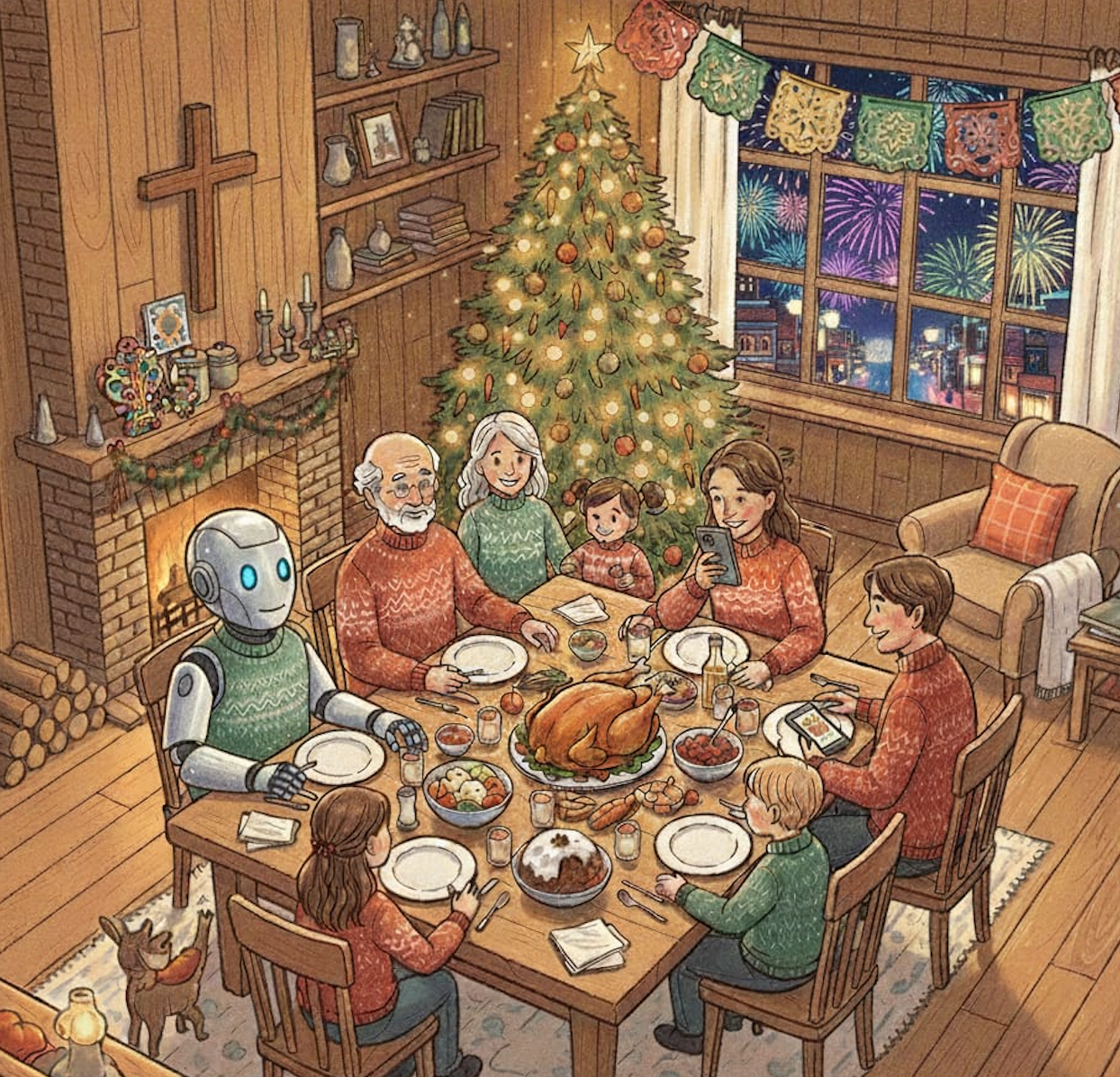
But this last week, I was astonished. Being in December, I expected more messages about the holiday season, Santa Claus, and Jesus being born, but I was greeted on a rainy Monday morning with something different to my expectations. My dear Grandma sent me an image of Jesus eating cake with the three wise men and ol\’ Saint Nick near a fireplace in a log cabin. I instantly knew this was an AI image, and I replied to my grandma jokingly that it was fake since obviously Santa lived on the North Pole. My grandma, however, replied with a simple “I know, I made this image”. Next time I saw her, I asked her how she managed to create such an image. She told me my aunt taught her how to do one on the phone, thanks to Gemini, and she went crazy with it.
An 83-year-old woman was able to learn a new technology with such quickness that she instantly went back to doing her traditional seasonal greetings and sharing them with her family and community, simply amazing. Events similar to this must have been replicated similarly with many types of technology, a furnace used for cooking, a book used for reading stories or any other piece of technology welcomed as a new part of tradition.
Thanks to this fun story, I firmly believe that technology and tradition do not battle each other; they enable each other. They dance in a chaotic dance of human experience and expectations in a manner that eventually becomes normal until the music changes again. One disrupts and brings change, and the other transforms and archives it for all to enjoy, bringing us a change in our society, and I believe there is some beauty in this that we must recognize and sometimes accept.
So thanks to the power of technology, writing from the other side of the world and with the most grateful of the holiday’s spirits in my mind, I want to wish you all a happy holiday season and a Happy New Year!