

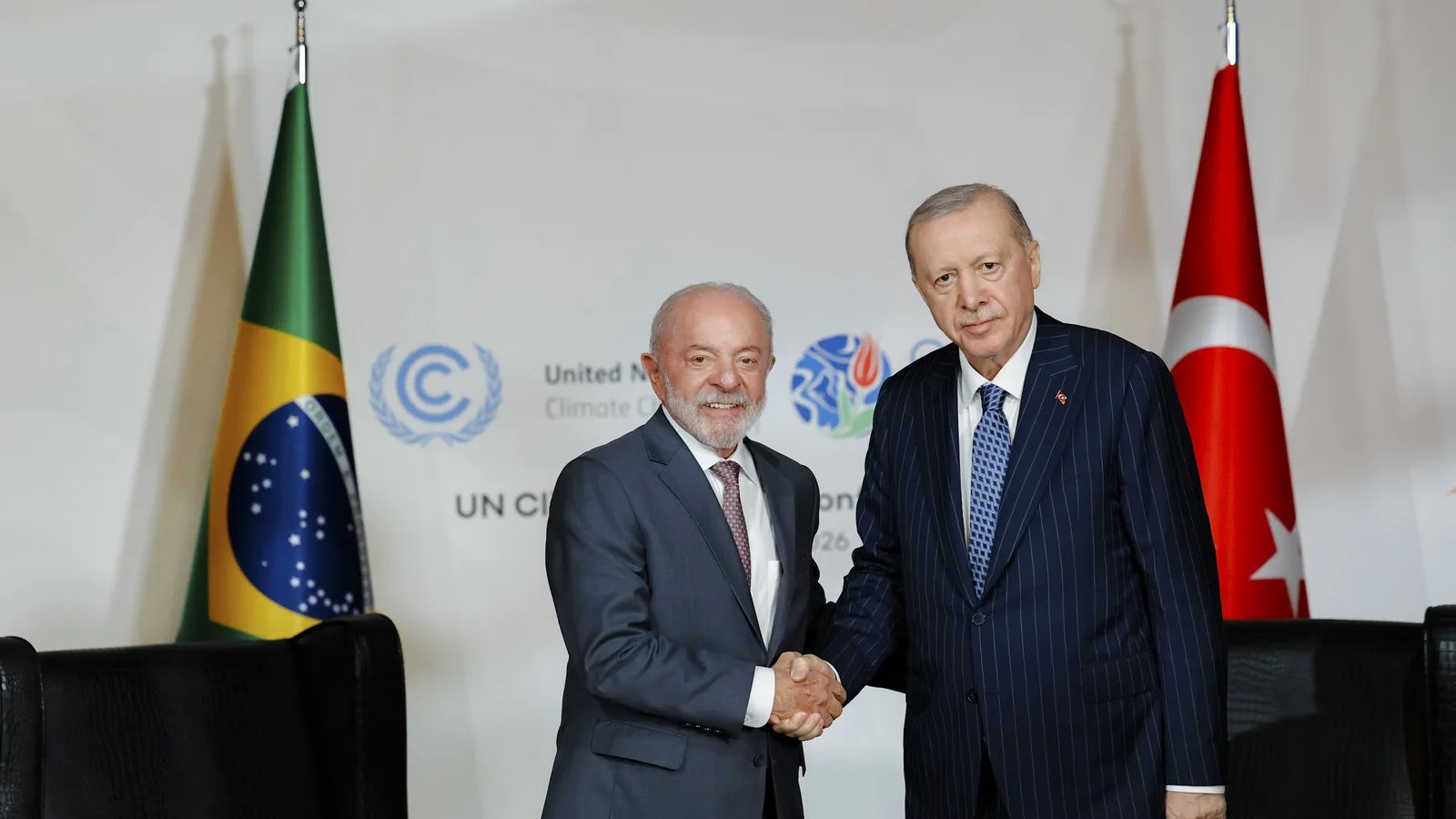
Andrea Saavedra While thinking about what to write for this article, I turned to the notes on my phone, where I usually jot down all the subjects I want to learn more about through writing. They are a curious mix of topics, ranging from identity politics—which I still owe you an article on—to Indigenous ontologies. Despite this long list of possibilities, I keep coming back to an event of global significance taking place at this very moment: COP31, the United Nations Climate Change Conference, held this year in Antalya, Turkey. This annual conference brings to light a contradiction that is difficult to ignore. Despite the agreements reached and the growing body of scientific evidence on the climate crisis, countries continue to struggle to translate their commitments into sufficient action to meet the goals of the Paris Agreement: keeping the rise in global temperature well below 2°C above pre-industrial levels and pursuing efforts to limit it to 1.5°C. In these negotiations, each nation’s economic, political, and strategic interests frequently come into conflict with the need for collective responses. While countries seek to protect their own priorities, they face a challenge that transcends their borders and that none can address alone. As we move dangerously close to these ecological limits, issues such as the energy transition, the gradual phase-out of fossil fuels, and the reduction of our dependence on plastics remain deeply contested. We seem more capable of imagining the consequences of ecological collapse than a world no longer dependent on the industries contributing to it. And while countries negotiate over their economic interests, the atmosphere recognizes no borders. In this world, which increasingly feels somewhat apocalyptic to me, we find ourselves grappling with questions of vital importance, even existential ones concerning our survival and that of the other species with which we share this planet. Maybe this is the spirit of our time, l’air du temps : an emotional, cultural, and social atmosphere permeated by uncertainty about what lies ahead. This uncertainty takes on a particular meaning for those of us in our twenties and thirties. Our circumstances are different from those of our grandparents and even our parents. They, too, lived through wars, threats, and turbulent times. Yet many of the struggles that shaped their generations revolved around what kind of society to build, which political project to defend, or which vision of the future should prevail. Today, another question has emerged alongside these, one that is perhaps more unsettling: how do we act when what is at stake is not only the future we want, but the very possibility of having a habitable future at all? Answering this question means confronting obstacles rooted in the societies in which we have grown up. We are constantly encouraged to think of ourselves as individuals, to pursue personal projects, compete, distinguish ourselves, and take responsibility for our own destinations. Yet we face a problem that goes beyond any individual or national project: preserving the conditions that make life on our planet possible. This is not merely an environmental question; it compels us to examine the social, economic, and political models that have brought us to this point, as well as our capacity to imagine alternatives. At the same time, emotions—and, more broadly, what the social sciences describe as affect —play a significant role in how we navigate this historical moment. Fear, anger, frustration, and anxiety influence our decisions and the ways we interpret the world. In times of uncertainty, we may find ourselves reacting more to the emotions events provoke in us than to the material conditions that produce them. We are surrounded by information, but this does not necessarily mean that our decisions are better informed, or that we know how to act upon what we learn. We seek refuge in our ideas and political convictions to find answers. Sometimes, the urgency of finding them leads us to cling to immediate certainties, even when they contradict what we know. Yet, regardless of our political positions, the physical transformations unfolding around us have no political color or ideology. Abrupt temperature changes, increasingly unpredictable weather patterns, water scarcity, wildfires, wars over resources… All of these are knocking at our doors. Of course, we do not experience these events equally: economic and social inequalities shape who is most exposed and who has the resources to protect themselves. However, in a world so globalized and connected through social media, it is increasingly difficult to claim that these problems do not concern us. Whether through action or inaction, we are all implicated. What we choose to see or ignore ultimately confronts us with something essential: the right to have our most basic needs met, including food, water, safe housing, and care. These concerns are becoming increasingly prominent in everyday conversations, public forums, television debates, and elections. They are not confined to any single nation or people, but cut across borders and bring into focus what connects us: our shared humanity, which challenges the divisions and hierarchies we have constructed around our differences. Our embodied existence reveals something fundamental: none of us can live without the material conditions that sustain life, nor can we exist independently of others, on whose care we have relied since birth. In fact, human history cannot be understood without these two dimensions of interdependence: first, our relationship with the Earth we inhabit; and second, our relationships with the human and more-than-human beings with whom we share this planet. In the face of the climate crisis, these relationships are no longer something we can take for granted. They confront us with a responsibility that extends beyond our individual lives. Yet recognizing our interdependence is one thing; knowing how to act upon it is another. This is where emotions become particularly important, shaping not only how we interpret the challenges of our time, but also how we respond to them. I wonder whether the very emotions that seem to deepen our divisions might also hold the potential for change. Anger, for instance, can move us out of passivity and lead us to become aware of both our capacity and our right to act. Nonetheless, feeling compelled to act does not necessarily tell us where to direct that energy. The same anger that brings us together can also turn us against one another. What, then, might help us find a common direction? This brings me back to the question running through this article: How do we act in the face of this sense of ‘no future’? I would venture to suggest that one possible path is to recover the memory of the relationships that sustain our existence. I am not referring to a nostalgic form of memory that idealizes a supposedly better past, but to one that resides in our bodies: the experience of having felt hunger, of having needed care, of having shared food, spaces, hardships, and hopes. These experiences are never exclusively individual. They are shaped by the relationships through which we grow, learn, and become who we are, as well as by the experiences and knowledge passed down across generations. In this sense, memory is also collective, reminding us that neither our identities nor what we have achieved can be understood as the result of individual self-sufficiency. This is what makes the memory politically relevant: it challenges the idea that our futures can be secured independently of one another. This tension between our interdependence and the pursuit of individual or national interests brings me back to COP31 and to the question that made it impossible for me to write about anything else. If our lives have always depended on relationships that extend beyond ourselves, how can countries continue to struggle to reach agreements on the very conditions that sustain them? I recognize that these negotiations involve unequal responsibilities, competing interests, and difficult political choices. Yet I cannot help but wonder whether, somewhere in these discussions, we have lost sight of the fact that the responsibility of states to ensure a dignified life for their people cannot be separated from the responsibility to preserve the world that makes such a life possible. Perhaps it is precisely this embodied and relational memory that we need to recover in these diplomatic spaces. Not because remembering our interdependence can solve all the world’s problems, but because it can offer an ethical starting point to guide our decisions: recognizing that there is no nation without society, no society without individuals, and no individuals without a world.
Anthropologist and Political Scientist
MSc in Sustainable Development
The Memory of a Future: Reflections on COP31 and What We Have Forgotten

Bu yazıyı 0% okumuştun.
Takip et

Blog'den son haberler