


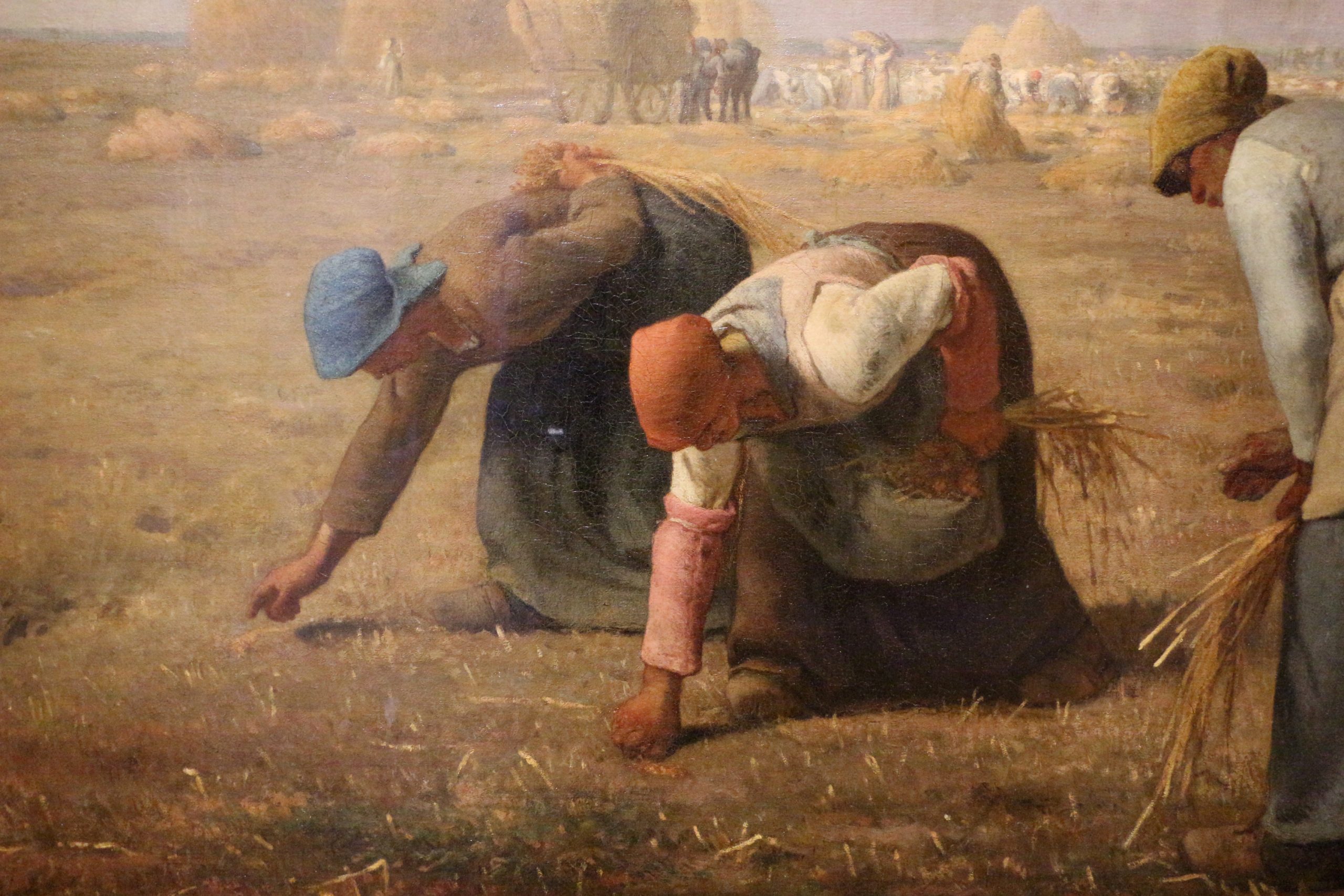
Jean-François Millet’s The Gleaners (1857) depicts three women collecting leftover grain after the harvest. The scene draws attention to labor, subsistence, and unequal access to land and resources. For this article, the painting is especially suggestive because it evokes the historical tension between private ownership and customary rights of use, as well as the often-invisible labor that sustains wealth and accumulation.
Written by Andrea Saavedra
Antropologist and political Scientist, Ms.c Sustainable Development
If it is valid to reflect on our collective state of mind as a society, I would argue that we are experiencing a crisis of meaning, caused, among other things, by the fact that we live in an eternal present from which we have convinced ourselves there is no way out. This feeling of being trapped in the present is well captured by what political scientist Francis Fukuyama called the end of history, or at least by what he understood as its endpoint: the consolidation of liberal democracy and the market economy as a horizon apparently without ideological alternatives of comparable force (Fukuyama, 1989). Taken into everyday life, this idea suggests that human society comes to see production, consumption, and economic growth as the only possible future or, at the very least, the only imaginable horizon of development and well-being.
In this world, in which we are immersed and whose possible consequences Fukuyama also began to anticipate, the ”meaning of life” becomes an individual task. We become increasingly individualized subjects and, in terms of our social relations with others, increasingly compartmentalized—that is, atomized according to our cultural, economic, or professional interests. Meaning becomes, then, fragmented across these different spheres and increasingly tied to the individual pursuit of accumulation and ownership as sources of status and recognition.
These ways of producing, consuming, and finding meaning are not merely economic practices; they also operate as ideological mechanisms because they ultimately define what we can imagine as possible. When production, consumption, accumulation, and growth cease to appear as one historical way of organizing society and instead become the only imaginable form, the present becomes eternal and immutable. It is within this sense of impossibility that, often without our being fully aware of it, forms of systemic malaise begin to emerge, increasingly affecting individuals across society.
In light of this, I propose—clearly from a critical perspective on the trajectory of society—that meaning cannot be found solely in a personal, individual path detached from the past; in other words, in a dehistoricized existence.
On the contrary, meaning is collective and, precisely because of its breadth, acquires a transhistorical dimension: it extends across generations, historical moments, ideas, values, and ideologies. It does not arise solely from the individual, nor is it confined to the present. Rather, it emerges from relationships and ways of understanding the world that precede us, that we inherit, and that we also transform. For this reason, I propose historicizing one of the most deeply rooted institutions in human history: property, understood as a historical construction whose naturalization has also led us to rely on it as a source of meaning in individual life.
Returning to the Past to Find Meaning in the Present: The Question of Property
Property, as Macpherson explains, is more than an object over which a person has control. It is also a social institution because it shapes relationships among people. Therefore, it is not enough to say that something belongs to me; that claim must also be supported by law and recognized by others. In this sense, property exists within the social relations that recognize and sustain it (Macpherson, 1978).
The history of land ownership makes this particularly clear. Today, private property can seem natural to us, but it was historically constructed. In many European contexts, and particularly in England, land was not organized only as something owned and controlled by one individual. Communal rights, customary uses, and different forms of shared access also existed. The commons, in this sense, were not organized mainly according to the logic of the market: people could hold rights to use and access land even when they did not own it exclusively.
In England, the enclosures progressively transformed these relationships. This process drew new boundaries, restricted access, and determined who could use a particular space. This process helped turn land into something that could be assigned a monetary value, bought, and sold (Polanyi, 1944; Neeson, 1993; Allen, 1992). It also had another consequence. As land increasingly became private and transferable property, many of those who had depended on the commons for their subsistence lost or saw their access to them restricted. Enclosure, therefore, changed not only people’s relationship with land but also the ways in which they could sustain their lives. As direct access to land and common resources declined, dependence on markets increased and, for part of the population, so did the need to sell their labor for wages.
These changes formed part of the broader development of capitalism in England and of modern forms of property. New rights were created, but so were new forms of exclusion and dispossession. Land that had previously been shaped by shared rights of use could increasingly be divided, valued, exchanged, and accumulated. This changed not only property relations over land, but also contributed to a broader way of relating to the world in which more and more things and resources could become property and enter the market.1
It is precisely this part of the historical narrative that we tend to forget. Property—whether land, an object, a fortune, or an estate—that today appears to belong to an individual has a history that exceeds that individual. From the commons and their transformation into private property to the commodities we produce, exchange, and possess, there are trajectories that precede the present moment. These trajectories contain accumulated labor, inheritances, institutions, territories, infrastructures, exchanges, and, in many cases, relations of exclusion that disappear from view when we look only at their present form.
Several authors allow us to observe, from different angles, what the eternal present tends to conceal. Marx, for example, shows us that behind the commodities we produce, exchange, and possess, there is always labor: a person, a period of time, material conditions, and relations of production that made their existence possible (Marx, 1867/1990). Yet when these products appear before us as commodities, we tend to see only the finished object and its value, while the social relations that produced it disappear from view. This is what Marx calls commodity fetishism: relations among people that come to appear as relations among things.
Mintz broadens this perspective by showing that a commodity is embedded in much wider geographical and historical relationships. Through an apparently everyday product such as sugar, he explains how its production, circulation, and consumption were shaped by deeply unequal relationships between places of production and extraction and places of consumption and accumulation. Sugar reveals how enslaved labor on Caribbean plantations, Atlantic commerce, and the expansion of European consumption made it possible to produce and concentrate enormous amounts of wealth, expand markets, strengthen commercial and financial circuits, and contribute to the accumulation of capital that accompanied the development of Atlantic and industrial capitalism (Mintz, 1985; Williams, 1944; Inikori, 2020).
Appadurai, meanwhile, takes us to yet another scale by proposing that things have a social life and that their value is not a fixed or natural quality of the object, but something that is constructed as the object circulates, is exchanged, and moves through different social, cultural, and political contexts. From this perspective, commodity status is not simply a fixed property of an object, but rather a phase within its social trajectory (Appadurai, 1986). Along that trajectory, value is also constructed through social relations, possibilities for exchange, and the political conditions that allow something to circulate, change hands, or remain outside the market. This is particularly useful for thinking about property: an object cannot be explained solely by who possesses it today, but also by the exchanges, uses, appropriations, and changes in value it underwent before reaching that moment.
This way of understanding value allows us to take the question a step further and distinguish between what a society considers valuable and what simply has a price in the market. Care, time, knowledge, nature, water, or the relationships that sustain life may hold fundamental value without this necessarily translating into a high price—or even without having a price at all. Likewise, what acquires a high monetary value is not necessarily what contributes most to collective well-being.
Rethinking value, therefore, means asking not only how much something costs, but also what relationships sustain it, what it makes possible, what it destroys, what it preserves, and for whom it is valuable. These questions become particularly important when the things that sustain life enter processes of commodification. If the market becomes our primary measure of what has value, we run the risk of confusing what can be bought with what we consider truly important.
For this reason, looking at property and value through these three lenses allows us to recover what the eternal present tends to conceal. Marx directs our attention toward the labor and relations of production hidden behind what we possess; Mintz toward the historical and geographical relationships connecting production, consumption, inequality, and accumulation; and Appadurai toward the social trajectories through which things circulate, change hands, and acquire value.
In this way, what today appears simply to ”belong to someone” ceases to be merely a present relationship between a person and a thing. Behind that property lies a history. To historicize property means, precisely, to restore to things the trajectory that the present tends to erase. This does not imply denying the right someone may currently have over them, but rather recognizing the historical relationships that made that property possible and asking what ethical implications follow from making them visible.
Property, Inheritance, and Debt as Forms of the Eternal Present
As we have seen, property does not exist only in this particular space and time. It has been historically constructed and therefore maintains important relationships with the past. If we think of property in terms of wealth accumulation, an ethical question emerges around inheritance. The ability to inherit wealth across generations and continue accumulating it contributes to reproducing inequalities in the present, particularly because people do not begin from the same material conditions. As Piketty has shown, the intergenerational transmission of wealth can play an important role in the reproduction and concentration of economic inequality over time (Piketty, 2014). These unequal starting points can become normalized, as though they were simply natural differences between individuals rather than the result of accumulated wealth transmitted across generations.
This production of inequality materializes in very concrete dimensions of well-being: security, access to education, networks, housing, time, the ability to take risks, and even the capacity to accumulate further wealth. The dilemma lies in the fact that while one part of the population is able to begin with already accumulated wealth and continue expanding it, another begins from different material conditions and depends primarily on what it can produce through labor. In some cases, debt also becomes a means of accessing goods and opportunities that others receive as inherited assets. Debt thus appears as the other side of accumulation: while some receive wealth built up over generations, others begin their economic lives by committing future income.
Viewed in relation to property, debt is more than a financial mechanism; it also shapes how time and opportunities for accumulation are distributed. Inheritance allows property or wealth built in the past to enter the present and become the starting point for further accumulation; debt, by contrast, requires those without such inherited assets to commit part of their future labor in order to gain access to goods that others receive as property. Inheritance and debt, therefore, express two profoundly different relationships with time: one allows a person to begin from wealth accumulated by previous generations; the other requires committing future income or labor that has not yet been produced.
These naturalized forms of accumulation and debt become particularly visible in the case of large inherited fortunes. While some individuals receive enormous estates and seek to expand that wealth, others have begun to question the transgenerational relationships that made such concentration possible. A particularly interesting case is that of Marlene Engelhorn, an Austrian-German heiress and descendant of Friedrich Engelhorn, the founder of BASF. The family fortune from which her inheritance originated was connected to Boehringer Mannheim, a German pharmaceutical company sold to the Swiss group Roche in the late 1990s. After receiving a multimillion-euro inheritance, Engelhorn publicly questioned how an individual could come to possess such economic power simply by being born into a particular family.
In 2024, she placed approximately €25 million in the hands of a citizens’ council composed of 50 people, who were tasked with deciding how those resources should be redistributed among different organizations. This initiative formed part of her broader criticism of the absence of wealth and inheritance taxes in Austria (Reuters, 2024). Engelhorn’s case does not, by itself, resolve the problem of inequality, nor does it turn individual redistribution into a substitute for public policy. But it does make visible an ethical question that the naturalization of inheritance tends to conceal: to what extent can birth justify such vast inequality in access to resources, security, and possibilities for life?
Engelhorn’s decision is particularly interesting because it shifts a question normally understood as private—what to do with what one inherits—toward a collective discussion about the distribution of wealth. If an individual response can challenge the apparently natural character of inheritance, public mechanisms of redistribution attempt to address the same tension at a societal scale.
In this sense, different European welfare systems seek, although in different ways and to different degrees, to intervene in these inequalities through taxation, transfers, and public services aimed at guaranteeing minimum conditions of well-being and reducing differences in people’s starting points (Esping-Andersen, 1990). Yet the idea persists that property and, therefore, wealth are essentially private assets, without sufficiently acknowledging the historical accumulation of well-being upon which they also depend.
This accumulated well-being can be seen in things we now take for granted. Transportation systems built over generations since the rise of the Industrial Revolution, the labor of those who built cities and infrastructures, the stewardship of land by farmers whose savoir-faire helps sustain society’s food supply, and the scientific, social, and artistic knowledge produced over centuries are also forms of accumulated value. Individual wealth is therefore never produced entirely in isolation: it depends on an enormous amount of labor, knowledge, institutions, and infrastructure collectively inherited from the past.
The New Enclosures and the Ethics of Property
The concentration and transmission of property affect not only those who inherit or accumulate it. They also have consequences for those who remain outside that accumulation. When part of society concentrates land, housing, resources, or capital, it does not merely increase its own access and well-being; it also changes the conditions under which others can access those same goods. This is where the new enclosures and the broader logic of exclusion reappear: no longer necessarily in the form of a fence dividing common land, but as an economic boundary that determines who can enter, remain, rest, live, or enjoy certain spaces and who cannot.
Silvia Federici has shown that enclosures do not belong only to the history of capitalism’s emergence, but continue to appear in new forms. Privatization, commodification, indebtedness, the erosion of public goods, and separation from the means necessary to sustain life are all part of what she understands as new enclosures (Federici, 2018). In this process, social relations and shared forms of care, cooperation, access, and the reproduction of life are also transformed.
If we bring this logic into our everyday experience, the new enclosures become both more visible and, at the same time, more difficult to notice. To leave our homes, meet others, rest, or simply remain for a few hours in certain spaces, we often have to consume. We sit in a café because we have bought something; we enter a club because we pay for membership; we access certain green or recreational spaces through compensation funds, entry fees, or affiliations; and we seek shelter in shopping malls because many of the spaces where we meet others are organized around consumption. Even activities as simple as sitting down, walking, using a bathroom, or remaining under a roof can increasingly depend on our ability to pay.
I do not mean by this that every recreational or private space should be free, nor that individual property is itself the problem. The question is different: what happens when our ability to inhabit the world becomes increasingly conditioned by our capacity to consume? The problem emerges when access ceases to be mediated by belonging, need, or shared use and comes to depend increasingly on our income.
This brings us back to the ethics of property. Property plays an important role in protecting autonomy: it allows us to have a space of our own, make decisions about our belongings, build a degree of security, and protect ourselves from the interference of others. But the right to possess also contains, almost always, a right to exclude. It is here that the tension emerges. How far can that right be justified when what others are excluded from is necessary to their well-being? What happens when purchasing power begins to determine access to rest, nature, housing, social interaction, or community? At what point does property cease to function as a protection of autonomy and begin to limit the autonomy of others?
Perhaps one of the reasons these boundaries appear so normal to us is precisely the eternal present. We have learned to think of market access as the natural way of accessing the world. We pay to enter, we pay to remain, we pay to rest, and little by little we stop asking whether it was always this way or whether it necessarily has to remain so. Yet the historical enclosures remind us that many of these boundaries had to be constructed. Their contemporary forms are no different.
Seen in this light, historicizing property allows us to make visible something that the present tends to hide: the boundaries between the private and the common, between what we can access freely and what we must pay for, are neither natural nor immutable. They are social, economic, and political decisions constructed over time. And if they were constructed, they can also be questioned and rethought.
Conclusion
Returning to the history of property allows us to ask what is truly valuable and where the systemic malaise from which this article began might lie. Perhaps part of that malaise arises precisely from living in a society in which access to well-being is increasingly mediated by the ability to pay. The new enclosures, in this sense, do not merely enclose spaces; they also enclose possibilities for life.
Looking backward also forces us to recognize that accumulation has never been entirely individual. From a Marxist perspective, we see that what we possess is underpinned by labor and relations of production; from Mintz, we learn to see the geographies of extraction, inequality, and accumulation that connect different territories; and from Appadurai, we learn to trace the social trajectories through which things circulate, acquire value, and eventually reach us. Taken together, what appears in the present as individual wealth contains, in fact, a much broader collective history.
With this in mind, historicizing property does not mean denying the possibility of ownership, but recovering the memory of everything that makes ownership possible. It means remembering that wealth does not begin with the person who currently possesses it, that value does not arise only in the market, and that well-being is not exclusively the product of individual effort. Property, like wealth itself, is embedded in relationships that precede and exceed whoever appears, at a particular moment, as its owner.
It is precisely for this reason that the eternal present must be reconsidered. We can return to the processes of Western history that brought us here, while also looking toward other historical and social experiences that have organized the relationship between property, value, well-being, and community in different ways. These include communal, peasant, and Indigenous forms of land use and care, as well as other social and political traditions that have not understood property exclusively through individual accumulation or an absolute right of exclusion. The point is not to idealize these experiences or to return to a supposedly better past, but to remember that what we now regard as inevitable is only one among many possible ways of organizing our relationships.
It is precisely within this opening that the past can recover its place as an ethical guide for action. It is neither distant nor anchored in a time that has already ended: it remains present in our institutions, in wealth, in inequalities, in the knowledge we have inherited, and in the ways we relate to others. Precisely because these institutions were constructed, they can also be transformed. Thinking about property in more relational terms—not only as the right of an individual over a thing, but also as a set of uses, responsibilities, and relationships with others—is only one of the possibilities that emerge once we stop thinking of the present as inevitable.2
Ultimately, historicizing our past does not mean allowing it to determine our actions. On the contrary, it means recognizing the relationships that remain present, understanding where they come from, and recovering our capacity to decide which ones we want to preserve and which ones we want to transform. Perhaps escaping the eternal present means precisely this: remembering that what we have today is not necessarily what must remain, because the future always remains open.
References
Allen, R. C. (1992). Enclosure and the yeoman: The agricultural development of the South Midlands, 1450–1850. Clarendon Press.
Appadurai, A. (Ed.). (1986). The social life of things: Commodities in cultural perspective. Cambridge University Press.
Esping-Andersen, G. (1990). The three worlds of welfare capitalism. Princeton University Press.
Federici, S. (2018). Re-enchanting the world: Feminism and the politics of the commons. PM Press.
Fukuyama, F. (1989). The end of history? The National Interest, 16, 3–18. https://www.jstor.org/stable/24027184
Inikori, J. E. (2020). Atlantic slavery and the rise of the capitalist global economy. Current Anthropology, 61(S22), S159–S171. https://doi.org/10.1086/709818
Macpherson, C. B. (Ed.). (1978). Property: Mainstream and critical positions. University of Toronto Press.
Marx, K. (1990). Capital: A critique of political economy (B. Fowkes, Trans.; Vol. 1). Penguin Books. (Original work published 1867)
Mintz, S. W. (1985). Sweetness and power: The place of sugar in modern history. Viking.
Neeson, J. M. (1993). Commoners: Common right, enclosure and social change in England, 1700–1820. Cambridge University Press.
Ostrom, E. (1990). Governing the commons: The evolution of institutions for collective action. Cambridge University Press.Escobar, A. (2018). Designs for the pluriverse: Radical interdependence, autonomy, and the making of worlds. Duke University Press.
Piketty, T. (2014). Capital in the twenty-first century (A. Goldhammer, Trans.). Harvard University Press.
Polanyi, K. (1944). The great transformation: The political and economic origins of our time. Farrar & Rinehart.
Reuters. (2024, June 18). Austrian pro-tax heiress gives wealth to social, climate, left-wing groups. https://www.reuters.com/world/europe/austrian-pro-tax-heiress-gives-wealth-social-climate-left-wing-groups-2024-06-18/
Williams, E. (1944). Capitalism and slavery. University of North Carolina Press.
- “Ownership of things did not, of course, originate with private ownership of land. However, the transformation of land into alienable property and a commodity formed part of a broader historical process through which exclusive property rights and market exchange gradually extended over an increasing range of goods and resources.” ↩︎
- “For readers interested in exploring these alternatives in greater depth, particularly useful points of departure can be found in Silvia Federici’s work on the commons, Elinor Ostrom’s research on the collective governance of common-pool resources, and Arturo Escobar’s writings on relationality, autonomy, and the pluriverse (Federici, 2018; Ostrom, 1990; Escobar, 2018).” ↩︎